Being Arab and Being A Mother
By Shereen Naser
Recently, my three-year-old and five-year-old, both named after Palestinian revolutionary women, watched Arab American comedian and show writer Ramy Youseef teach Elmo how to say some words in Arabic.
They made me replay the damn video maybe 50 times.
“Is Elmo real?” Leila asked me. I explained to her that Elmo is a puppet, but that someone real does make the voice and move Elmo around.
“Well now that person knows how to say habibi!” She was so excited.
Both my children know a smattering of Arabic words, mostly greetings and food words. They know the shape of Palestine enough that they find mirrors of it in everyday things like cracks in the sidewalk or a weirdly shaped potato chip. Leila shared her new favorite book, Jiddo’s Garden, with her kindergarten class.
My kids also know that they live in a place called the United States. They know enough to know that the reason we live here isn’t all great, the reason that our world looks the way it does isn’t always because of good choices that people made. Both my children know the Dakota origin stories and the Black Hills, they have a young person’s understanding of colonization, and also they love their schools, going on picnics, their friends, and the neighbors.
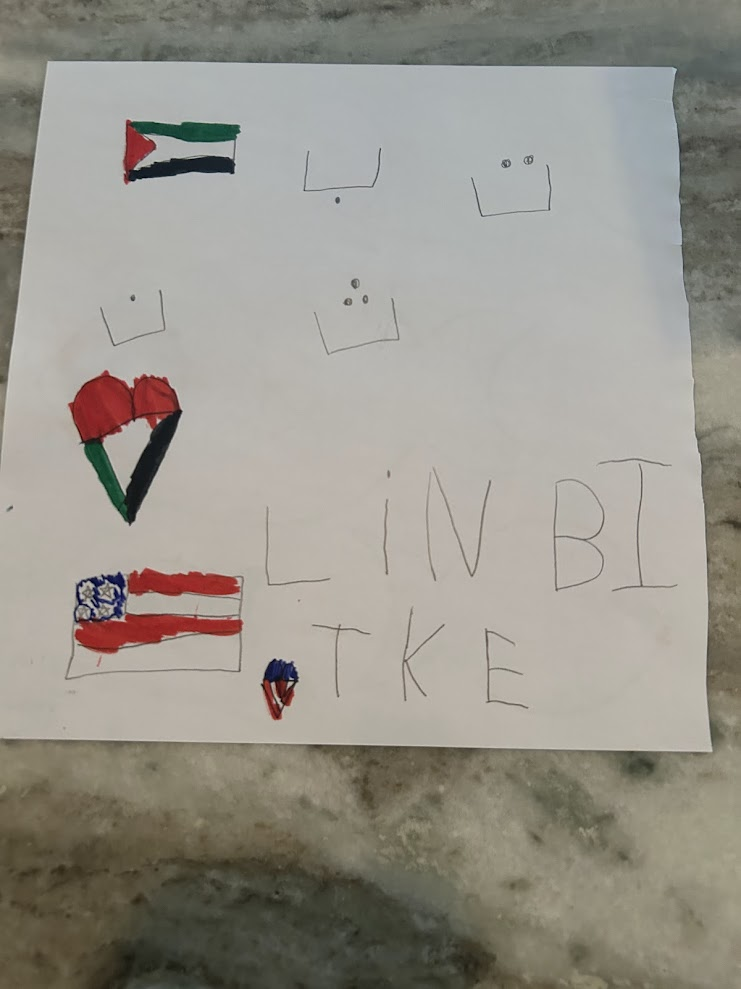
Somewhere in all of this mess, from the colonization of Palestine to the colonization of Turtle Island, my children have an image of their identity beginning to form. The other day, my girls drew Palestinian and American flags on a sheet of paper along with English and Arabic letters.
In my children’s world, Elmo knows English and a little Arabic. In their world, they have so many aunties and umos, and they speak so many different languages, and eat so many different kinds of foods, and the world is full of things that make us, as another book we read likes to say, same, same, but different.
I want them to hold onto this for as long as possible, because in my own research with Arab American youth, my kids’ stories about themselves are largely protected, but they won’t be for much longer.
Every day I wonder how much longer they have until stories about the Arab terrorist start to seep into their lives. Maybe it will come from a well meaning stranger, a stray YouTube video I hadn’t had a chance to vet yet, or as it has for many of the youth I’ve spoken to, it will come from their textbooks, their school friends, or their teachers.
The research tells us that exposure to discrimination is an experience that can greatly impact youth mental health. And that the greatest protection I can give my kids to mitigate that impact is pride in who they are, pride in being Palestinian, pride in being Arab, and rootedness in the cultural practices and values of our people. I feel like, as a Palestinian in diaspora, this is a gift I happily give my children because it is a gift that also feeds me. Teaching my kids tatreez, making them manaeesh for a snack, teaching them about the incredible Arab and Palestinian poets, scientists, engineers, teachers, inventors, and thinkers who have contributed such beauty to this world. This is the armor I offer them against a world that sees their lives as expendable, that paints our people as backwards and unworthy.
But even our occupier would be nowhere without us. As they try to steal our land, covet our culture, and appropriate our way of life, I see jealousy in the violence.
We have so much to be proud of, and I teach my children that pride.
Today, I’m thankful to Ramy Youseef and Elmo for bringing a spark of joy to my children to see such a mainstream character speaking Arabic. I am thankful to people like Ms. Rachel and Sesame Street for showing my children they belong. Because there will be lots of other narratives about who they are and their heritage that won’t be so great. And all I can do is keep making sure the good outweighs the bad.