Our Existence Is Resistance
By Alaa Muhammad
Every June, thousands gather at Wade Oval for Parade the Circle, a Cleveland tradition that celebrates art, creativity, and community. Founded by the Cleveland Museum of Art in 1990, the parade invites participants to express themselves through large-scale public art while sharing stories that connect us to our histories, cultures, and communities.
This year’s theme, Momentum, was inspired by textiles, lived experiences, and the stories that continue to move us forward. In describing the theme, lead artist Héctor Castellanos Lara reflected on growing up surrounded by sewing machines, fabric, colors, patterns, and the women who transformed cloth into something meaningful. He spoke about drawing inspiration from both textiles and personal experiences, reminding participants that our stories of sacrifice,
resilience, and creativity continue to push us forward.
For Palestinians, that theme immediately resonated. We are a people who, for most of our lives, have fought not only for a free Palestine, but for the right to tell our own story. We have spent generations preserving our history while watching others attempt to erase it. When your history is being burned down, preserving culture becomes an act of resistance.
You teach the songs.
You pass down the recipes.
You tell the stories your grandparents told you.
You sew the patterns your grandmother taught your mother, and your mother taught you.
You refuse to let your people be forgotten.
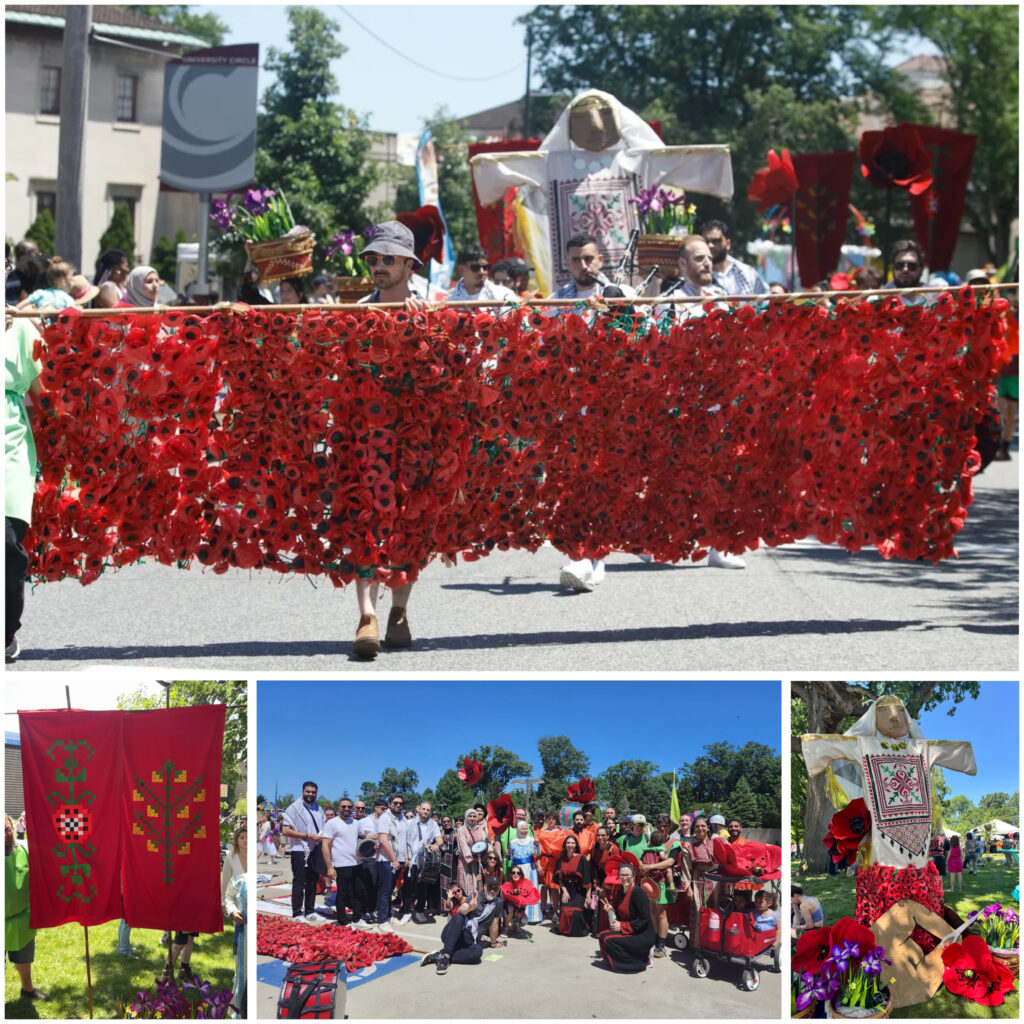
That understanding became the inspiration behind our ensemble, Momentum of the Land. With more than fifty participants, our community came together to create one of the largest ensembles in this year’s parade. Every piece of art carried meaning. Every banner, flower, basket, stitch, and drumbeat told part of a larger story about Palestine, its people, and its enduring connection to the land.
At the heart of our presentation was Tatreez, the traditional Palestinian art of embroidery. More than decoration, Tatreez is a living archive. Each pattern tells a story about a village, family, landscape, or way of life. Long before our stories were written in books, they were sewn into dresses and passed from one generation to the next.
The beautiful motifs featured throughout our ensemble were inspired by the work of Palestinian artists @shereen.quttaineh and @falasteeniya. We were honored that they allowed us to display their work and share these designs with the thousands of people who attended the parade. Their patterns transformed traditional embroidery into large-scale public art, allowing
stories usually worn on sleeves and thobes to be seen across Wade Oval.
The giant sewing hands at the heart of our ensemble honored the generations of Palestinian women who preserved our culture through Tatreez. The hands, adorned with embroidered sleeves, symbolized the labor, love, and resilience of those who carried our history forward despite displacement, exile, and occupation. The woman dressed in a traditional Palestinian thobe represented the generations of women who have served as keepers of culture, memory,
and identity.
Our baskets were inspired by the henna baskets traditionally carried during Palestinian weddings. Often filled with henna, jewelry, and gifts for the bride, our baskets instead carried the Faqqua Iris, Palestine’s national flower. Participants also carried red poppies, flowers deeply associated with Palestine and reflective of the colors of our flag.
One of the most powerful pieces in our ensemble was the wall of poppies, part of The Poppy Project, an ongoing community art initiative creating one tissue-paper poppy in honor of each Palestinian child martyred since October 2023. Standing together, these thousands of flowers served as both a memorial and a reminder that behind every statistic is a child, a family, and a
story.
Leading our procession was @zaffetna__group, whose traditional Zaffe filled Wade Oval with music, celebration, and joy. A Zaffe is a festive procession of drumming, singing, and dancing commonly seen at Palestinian weddings and celebrations. Their energy carried our ensemble through the route and reminded everyone that Palestinian culture is not only defined by
struggle, but also by community, beauty, and life.
For Palestinians, cultural expression has often faced restrictions. Throughout our history, our symbols, our stories, and even our identity have been challenged. Yet time and again, our people have found new ways to preserve who we are. When one symbol is restricted, another emerges. When one voice is silenced, another finds a way to speak, and our story persists.
That spirit of sumud; steadfastness, continues today.
The official theme asked participants what story they would bring to the parade.
Our answer was Palestine.
We brought a story about a people deeply connected to their land. A people who continue to preserve their traditions despite displacement and adversity. A people who continue to create, celebrate, teach, remember, and resist.
Most importantly, we brought a story about culture. Because for Palestinians, culture is not separate from our struggle, it’s woven into it. It is how
we preserve our history. It is how we honor those who came before us. It is how we ensure future generations know who they are and where they come from.
Every person who painted, built, sewed, carried, marched, played music, folded flowers, organized, and supported this ensemble helped tell that story. And for that, we are deeply grateful.
Our existence is resistance.